Artist
Rena Kyriakou
26 followers
Rena Kyriakou was born in Heraklion, Crete, on 25 February 1917. Child prodigy, internationally acclaimed pianist, composer, and pedagogue. She was a member of the Greek Composers’ Union. The daughter of well-known architect Dimitrios Kyriakou and Kakia Archaniotaki, Rena grew up in a cultured environment that appreciated her talent and fostered its development very early on. On 31 December 1923, at the age of six, she made her first public appearance at the Parnassos Concert Hall, performing exclusively her own compositions (from Fifteen Children’s Pieces [Δεκαπέντε παιδικά κομμάτια]), which were greeted with positive comments by such musicians as Georgios Lambelet, Marios Varvoglis, Georgios Sklavos, Dionysios Lavrangas, Theodoros Synadinos, Manolis Skouloudis, Ivan Boutnikov, and Frank Choisy. These early works sustain a programmatic character with a marked romantic idiom. The Kyriakou family then went to Paris in order to seek the expert opinion of neuropathologists and musicians. According to the verdict issued by Charles Richet and the composers of the modern French school Albert Roussel, Gabriel Pierné, Jean Déré, and Vincent d’Indy, little Rena was a performing and composing genius. In Berlin, she played in the form of auditions before Franz Schreker, George Szell, and Max Von Schillings, winning praise once again. She completed theory and harmony with Richard Stöhr (Munich and Vienna), and Dr. Paul Weingarten (Vienna). She had her first piano lessons with Hilda Müller-Pernitza, Anghelos Kesisoglou, and Paul Wittgenstein. In Paris, Isidor Philipp, Gabriel Pierné, and Nadia Boulanger prepared her for the CNSMDP entrance exams. In September 1930, among 124 candidates, Rena Kyriakou was among the top five, and was admitted to the CNSMDP, in the piano class of Isidor Philipp, and the harmony class of Jean Gallon. In 1931, her works Kloster, op. 1/Α.Κ.Σ.Ρ.Κ. 35, and Burlesque no. 1, op. 1/Α.Κ.Σ.Ρ.Κ. 36, were presented at the Société Nationale de Musique de Paris concerts (the first participation of a Greek female composer), receiving excellent reviews. In 1933, her composition teachers Henri Büsser and Jean Gallon, sure of her success, proposed her for the 1934 Prix de Rome. Elena Venizelou (who financed her studies) did not allow her to take part in the competition. In 1932, Rena Kyriakou was awarded the Deuxième Prix de Piano for her performance of Fryderyk Chopin’s Sonata in B flat minor; in 1933, she graduated from the CNSMDP, winning the Premier Prix de Piano for her performance of Robert Schumann’s Symphonic Variations, op. 13, and an atonal work by Florent Schmitt. The Premier Prix was her ticket to the historic concert halls of Europe and America, where she introduced herself as a composer too, placing her works among those of Chopin and Liszt, or playing them as encores. She signed a contract for a world tour with the Office Théâtral Européen. At an international level, she got enthusiastic reviews, both for her high-quality interpretations and the originality of her compositions; the music critics placed her among the top musicians of the time. She gradually came to the decision to devote most of her time to discography. She passionately dedicated herself to recordings, convinced that they were the way to remain in her audiences’ consciousness. With Isidor Philipp’s consent, she turned to research and promotion of piano works by hitherto neglected composers like Felix Mendelssohn, Emmanuel Chabrier and Isaac Albéniz, producing their complete works in collaboration with Vox. For the same company, she recorded works by Antonio Soler, John Field, Jan Dusík, Enrique Granados, Fryderyk Chopin, and Gabriel Fauré, among others. She had a prodigious memory, and never used a score, to the surprise of all the great conductors she collaborated with, such as Hans Swarowsky, Carl August Bünte, Robert Wagner, Edmond Appia, Hubert Reichert, Mathieu Lange, Karl Rucht, Christian Vöchting, Václav Smetáček, Rudolf Kempe, Maurice Le Roux, Armin Jordan, Rudolf Moralt, Toni Louis Alexandre Aubin, Henri Rabaud, Sir Malcolm Sargent, Georg Solti, Jean Meylan, Dimitri Mitropoulos, Dimitris Chorafas, Miltiadis Karydis, Theodoros Vavayannis, and Andreas Paridis. She also collaborated with such famous orchestras as the Vienna String Symphony Orchestra, the Vienna Pro Musica Orchestra, the O.S.R., the London Philharmonic Orchestra, the Philharmonia Hungarica, the Orchestre de la Société des Concerts du Conservatoire de Paris, the Torquay Symphony Orchestra, the Westfalen Symphony Orchestra, the Innsbruck Symphony Orchestra, the Berlin Symphony Orchestra, and the Athens and Thessaloniki State Orchestras. Her recordings of Chabrier are considered superior to those by Arthur Rubinstein, Marcelle Meyer, Pierre Barbizet, Paul Badura-Skoda, and Louis Kentner. Her discography of Mendelssohn has been deemed better than the corresponding renderings by Guiomar Novaes and Rudolf Serkin, and equal to those of Cortot, Horowitz, Perahia και Thibaudet, while her Haydn recordings were pronounced superior to those of Fritz Neumeyer. She was made Dame of the British Empire, and Chevalier de France, L’Ordre des Arts et des Lettres, for her interpretations of Mendelssohn’s and Chabrier’s complete works respectively. She became the third honorary member of the International Mendelssohn Society after Pablo Casals and Alfred Cortot. The Viceroy of Yugoslavia conferred the Croix de l’Ordre de Saint Sava, Chevalier de Yougoslavie, upon her. In 1943, she premiered her Concerto for Piano and Orchestra, op. 18/Α.Κ.Σ.Ρ.Κ. 74 (the first piano concerto by a Greek female composer), with conductor Theodoros Vavayannis and the Athens State Orchestra, at the Pallas Concert Hall. It was performed again in Geneva in 1954, with the O.S.R. under the baton of Jean Meylan, and at the Athens Concert Hall in November 2009, with pianist Domna Evnouchidou, and Miltos Logiadis conducting the Athens State Orchestra. It was difficult for Rena Kyriakou to achieve recognition as a composer in Greece, due to the different sound of her works as well as her sex. She was active at a time when Greek music had to be ‘national’ in character in order to survive. And at such a time, she dared to propose her own personal idiom. Greek audiences were not prepared to appreciate experimentation of that kind. Her works Tango, Α.Κ.Σ.Ρ.Κ. 28, and Burlesque no. 2, op. 9/Α.Κ.Σ.Ρ.Κ. 54, were published by Durand, Paris, while Perpetuum Mobile, op. 15/Α.Κ.Σ.Ρ.Κ. 70, was published by Carl Fischer, New York. From June 1950, she served repeatedly as jury member at major piano competitions, like the annual CNSMDP competition, the Concours International d’Exécution Musicale de Génève, and the Montreal International Piano Competition. Rena Kyriakou died of cancer at Moschato, Athens, in August 1994. Christina K. Giannelou . User-contributed text is available under the Creative Commons By-SA License; additional terms may apply.
Popular
Songs without Words, Book V, Op. 62: No. 30 in A Major "Spring Song"
Classical Music for Yoga and Relaxation

Piano Concerto No. 2 in D Minor, Op. 40
Mendelssohn Piano Concertos 1 & 2

Variations sérieuses in D Minor, Op. 54, MWV U156
Mendelssohn: Variations sérieuses, Op. 54, Vladimir Horowitz vs. Vladimir Sofronitsky vs. Rena Kyriakou (Compare 3 Versions)

Capriccio Brillant Op. 22 For Piano And Orchestra - Andante Allegro Con Fuoco
Mendelssohn - Piano Concerto
Albums

Albéniz: Complete Piano Music, Vol. 2
2025
Mendelssohn Piano Concertos 1 & 2
2016

Romantic Piano Concertos, Vol. 8
2015
Mendelssohn: Variations sérieuses, Op. 54, Vladimir Horowitz vs. Vladimir Sofronitsky vs. Rena Kyriakou (Compare 3 Versions)
2014

Felix Mendelssohn Bartholdy: Masters of Music, Vol. 41
2013

Felix Mendelssohn: Piano Concerto in A Minor
2013

Mendelssohn: Piano Concerto No. 2 and Solo Piano Works
2013

Mendelssohn: Piano Concerto No. 2 in D Minor, Op. 40 - Scherzo a capriccio in F Sharp-Minor - Perpetuum mobile, Op. 119 - Fantasy
2013

Mendelssohn: Three Piano Sonatas
2013

Milhaud / Chabrier / Faure / Ravel / Brahms
2000

Chabrier: Complete Piano Music
1994

Albéniz: Música Española
1993

Mendelssohn: Piano Concerto No. 2 and Solo Piano Works
1991

Albéniz: Complete Piano Music, Vol. 1
1974

Beethoven & Dussek: Piano Concertos
1970

Chabrier: Complete Piano Music, Vol. 1
1966

Chabrier: Complete Piano Music, Vol. 2
1966

Haydn: Keyboard Sonatas, Vol. 3
1966

Haydn: Keyboard Sonatas, Vol. 4
1966

Mendelssohn: Piano Music, Vol. 1
1962

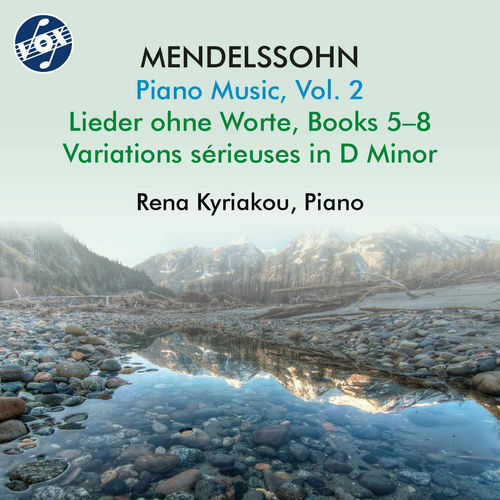
Mendelssohn: Piano Music, Vol. 2
1962
Classical Music for Yoga and Relaxation
Similar Artists
Saint Petersburg Conservatory Chamber Orchestra
Olga De Roos
Sergei Beloglazov
Jurgis Karnavičius
Saint Petersburg Zazerkalye Theater Orchestra
Barbara Miller
String Quartet Luzern
Wesley Baldwin
Andrea Kauten
Marcin Markowicz
Kelly Burke
Aldona Dvarionaité